
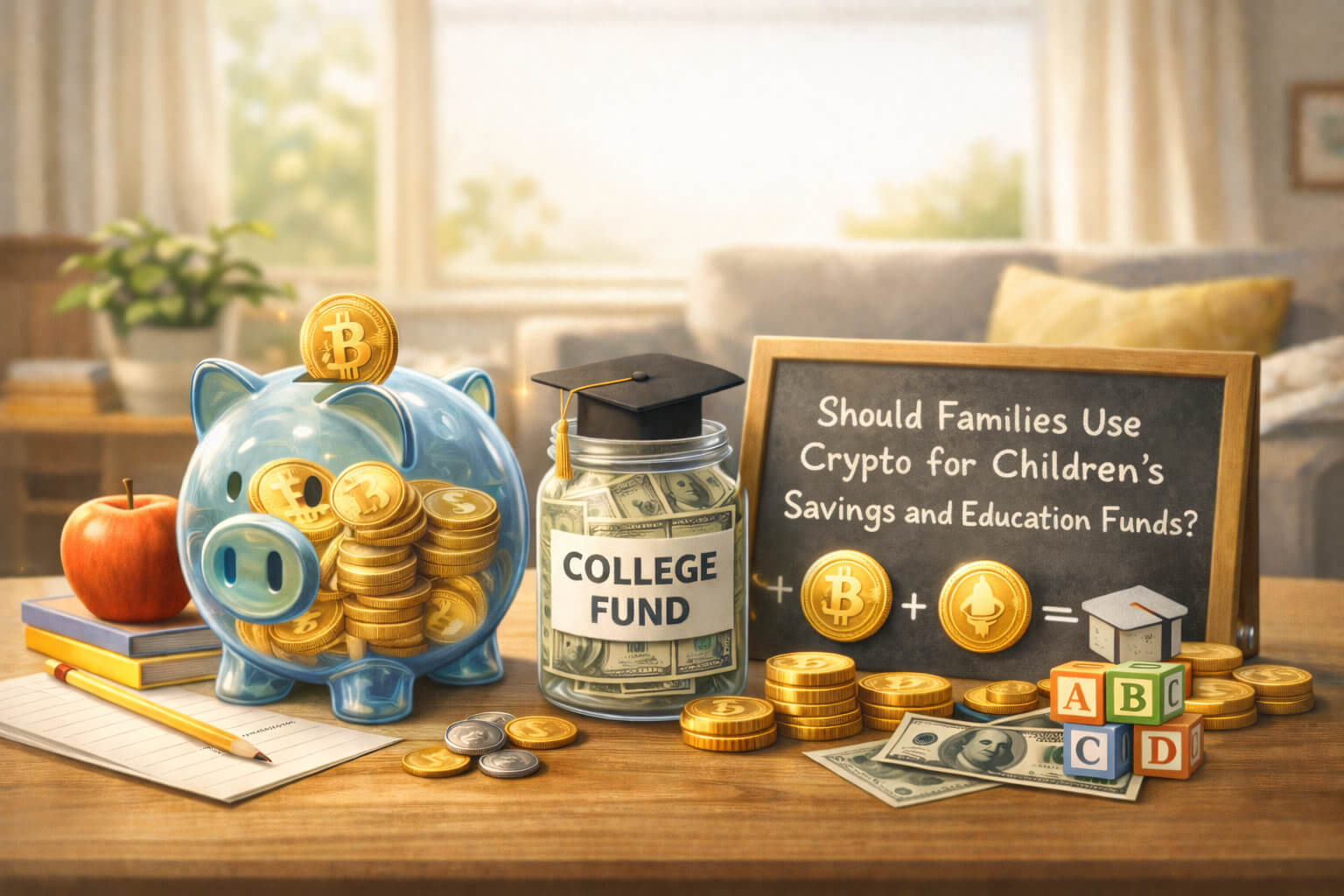
Why might cryptocurrency belong in children’s savings and education funds?
A small, long-horizon crypto slice (often 1–5%) can add optionality to a child’s portfolio and—equally important—create a hands-on way to teach digital finance without letting volatility dominate the plan. Historically, Bitcoin’s correlation with major equity indexes has often been low-to-moderate over long samples (with meaningful regime shifts over shorter windows), which is why a tiny allocation can sometimes improve portfolio diversification.
The key is to treat crypto as a satellite, not the core. Large drawdowns (50%+) are normal, regulations can change, and operational mistakes (lost keys, phishing, bad platforms) are unforgiving. If you keep the allocation small, automate contributions, and review it annually, the “education value” can justify the experiment even when returns don’t.
That naturally raises the practical question: where would crypto sit compared with the usual kids’ vehicles?
How does cryptocurrency compare with 529 plans and custodial accounts for kids?
For most education-first goals, a 529 is still the default winner: tax advantages, donor control, and typically friendlier financial-aid treatment. Parent-owned 529 assets are generally assessed at a much lower rate than student-owned custodial assets in federal aid formulas.
Crypto, by contrast, usually lives in a taxable account structure (or via ETP/ETF wrappers). In the U.S., spot Bitcoin ETP shares were approved for listing and trading on Jan. 10, 2024, which made “crypto exposure” easier to implement in standard brokerage accounts.
Here’s a simple side-by-side (one table, as requested):
| Feature | 529 plan | UGMA/UTMA custodial account | Crypto in a taxable account (direct or via ETP/ETF) |
|---|---|---|---|
| Best use | Education-first savings | Flexible goals beyond education | High-volatility “satellite” + financial literacy |
| Taxes | Tax-free qualified education withdrawals; state perks vary | Taxable gains/dividends (child’s account) | Taxable when sold/spent; record-keeping essential |
| Control | Adult controls; beneficiary can be changed | Child gains control at age of majority | Depends on account + custody setup; can be complex |
| Financial aid (typical) | Often treated as parent asset (lower assessment) | Often treated as student asset (higher assessment) | Mirrors the account owner (custodial = student-asset impact; parent taxable = parent-asset impact) |
| Can hold crypto directly? | Generally no | Can hold ETP/ETF; direct crypto depends on platform rules | Yes (direct custody) or via ETP/ETF |
Once you decide where crypto fits, the next step is deciding how to size it and contribute without letting emotions drive timing.
What cryptocurrency allocation and DCA strategies work for a child’s portfolio?
Start with the principle: the child’s overall portfolio is the portfolio—crypto is just a small sleeve inside it. If you’re keeping crypto at 1–5% of total assets, you can keep the crypto sleeve itself simple (usually one or two liquid, long-lived assets) and focus more on process than picking “the next winner.”
A practical approach is automated DCA plus disciplined rebalancing:
- DCA (weekly or monthly) reduces the urge to “buy the dip” emotionally.
- Rebalancing (annually, or when crypto drifts materially above target) forces you to trim after big run-ups and top up after crashes—mechanically controlling risk.
Step-by-step guide: set up a “crypto satellite” for a child in 7 steps
- Pick the vehicle: parent taxable brokerage, UTMA/UGMA, or trust—choose based on control and financial-aid implications.
- Set the cap: decide a hard maximum (e.g., 1–5% of the child’s total long-term savings).
- Choose simple exposure: direct custody or a spot Bitcoin ETP/ETF wrapper (approved in the U.S. on Jan. 10, 2024).
- Automate DCA: fixed amount on a fixed schedule; don’t improvise based on headlines.
- Define rebalancing rules: review once per year; rebalance back to target if the sleeve gets too large.
- Lock down custody + access: hardware keys, strong 2FA, and a recovery plan (details below).
- Teach one concept per quarter: wallets, fees, stablecoins, security hygiene, and taxes—small lessons that compound.
With sizing and automation set, the biggest remaining determinant of outcomes is whether the assets are secured correctly.
How can families secure and custody cryptocurrency responsibly?
Security should match the mission: long-term family savings means minimizing single points of failure. For many families, the cleanest hierarchy is:
- Long-term holdings: cold storage (hardware wallet) and hardened account security (hardware security key-based 2FA where applicable).
- Redundancy: multi-party control (e.g., multisig or an institutional-grade custody setup) so one mistake doesn’t wipe out the fund.
- Succession: written instructions kept offline, and an estate plan that explicitly addresses digital assets.
This isn’t only about theft—it’s also about loss. If the adult managing the funds becomes unavailable, the child’s education plan shouldn’t die with a forgotten passphrase. That naturally leads to the rules and paperwork side: taxes, gifting, and compliance.
What taxes and legal considerations affect family cryptocurrency for education?
In the U.S., crypto is treated as a digital asset with taxable events when you sell or dispose of it, so “funding tuition with crypto” usually means realizing gains first. The IRS’ digital assets guidance is the right starting point for how dispositions and income events are treated.
A few common family scenarios:
- Selling crypto to contribute cash to a 529: the sale is taxable; the 529 contribution itself is just a contribution.
- Gifting to a child (UTMA/UGMA or otherwise): the annual gift-tax exclusion was $18,000 in 2024 and $19,000 in 2026 (per donee, per donor).
- “Superfunding” a 529 (5-year election): in 2026, five years of annual exclusions implies up to $95,000 per beneficiary per donor (or $190,000 for couples who gift-split), subject to the election/filing mechanics.
- Staking rewards: the IRS has issued guidance indicating staking rewards are generally included in income when the taxpayer has control over them (then later you have capital gain/loss when sold).
(Also: financial-aid rules can vary by program and school methodology; federal FAFSA treatment differs from some institutional formulas.)
Once the structure and compliance are clean, examples help calibrate expectations—both the upside and the failure modes.
What real-world cryptocurrency examples show outcomes for education savings?
Real outcomes usually come down to discipline + sizing, not cleverness:
- Small DCA into Bitcoin: can build meaningful value over time, but the path often includes severe drawdowns—this is why the allocation cap matters.
- Ethereum’s environmental shift: if a family cares about footprint, Ethereum’s move to proof-of-stake reduced energy consumption by roughly 99.95% (often cited as ~99.95%–99.99% depending on methodology).
- ETP/ETF wrapper convenience: since U.S. spot Bitcoin ETPs were approved on Jan. 10, 2024, many families use brokerage custody and standard statements to simplify tracking and reduce operational risk.
- Cautionary tales (platform risk): failures and freezes have shown why “not your keys” matters for long-term holdings—another reason to avoid overconcentration and to document recovery.
Taken together, the coherent playbook is: use a 529 for the education core, and only add a small, automated crypto satellite if you also want the hands-on learning—and you’re willing to do security and taxes properly.